BCA Course Guide: Semester-wise Subjects, PDF Notes & Study Material

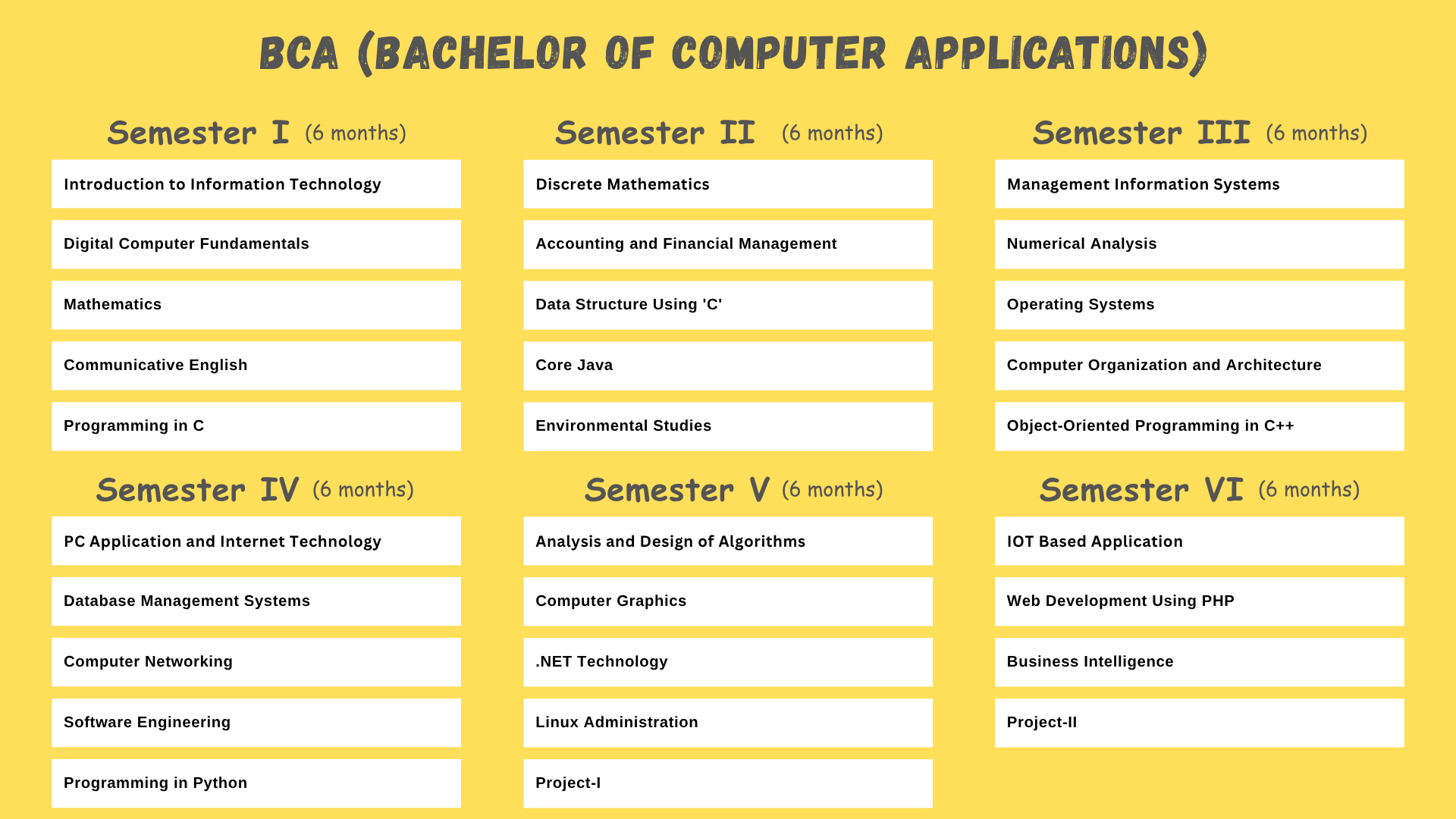
Access the complete BCA (Bachelor of Computer Applications) roadmap. Download semester-wise PDF notes, detailed syllabus, and unit-wise study material. Everything you need to prepare for your exams and master the course is right here.
1️⃣ Semester (I)
| Introduction to Information Technology |
| Digital Computer Fundamentals |
| Mathematics |
| Communicative English |
| Programming in C |
➡️ Introduction to Information Technology
UNIT-I: Computer Basics
- Introduction
- Evolution of Computers
- Characteristics of computers
- Computer Generations
- Classification of Computers
- Computer Applications
- Limitations of computers
UNIT-II: Computer Organization, Memory and Storage
- Introduction
- Basic Computer Organization
- Input Devices
- Output Devices
- Central Processing Unit
- The System Bus Architecture
- Memory or Storage Unit
UNIT-III: Information Technology Basics
- Introduction
- Need for Information Storage and Processing
- Information Technology Components
- Role of Information Technology
- Information Technology and the Internet
UNIT-IV: Emerging Trends in IT
- Introduction
- Electronic Commerce
- Electronic Data Interchange
- Smart Cards
- Mobile Communication
- Internet Protocol TV
UNIT-V: MS WINDOWS / MS Office
- Introduction to Windows
- Components of Windows
- Customizing the Desktop
- Files and Folders
- An overview of MSWORD, MSEXCEL, and MSPOWERPOINT
➡️ Digital Computer Fundamentals
UNIT-I: Number System
- Decimal numbers
- Binary numbers
- Binary arithmetic
- 1’s and 2’s Complements
- Octal numbers
- Hexadecimal numbers
- Inter-conversions of number systems
Unit II: Digital Codes
- Binary coded decimal (BCD)
- Gray code
- Excess-3 code
- ASCII code
Unit III: Logic Gates 1 and 2
- Positive and negative logic
- NOT gate, OR gate, AND gate, NOR gate, EX-OR, and EX-NOR gates
- Symbols and truth tables
- Universal properties of NAND & NOR gates
- Conversion of logic gates using NAND & NOR gates
Unit IV: Boolean Algebra 1 and 2
- Boolean operations
- Logic expressions
- Rules and laws of Boolean algebra
- DeMorgan’s theorems
- Simplification of Boolean expressions using Boolean algebra techniques
Unit V: SOP and POS 1 and 2 / Combinational Circuits
- Form of Boolean expressions for a logic network
- Min-terms and max-terms
- Simplification of Boolean expressions using Karnaugh map techniques (up to 4 variables)
- Difference between combinational and sequential circuits
- Multiplexer and Demultiplexer
- Adder and Subtractor
- Flip-Flops
➡️ Mathematics
UNIT-I: Matrix Theory
- Introduction
- Elementary row and column transformation
- Inverse of a non-singular matrix by elementary transformation
- Rank of a matrix
- Invariance of rank under elementary transformations
- Determination of the rank of a matrix by reducing it to echelon form
- Linear equations
- Homogeneous linear equations
- Non-homogeneous equations
UNIT-II: Mathematical Logic
- Open sentences
- Compound open sentences
- Quantifiers
- Truth sets
- Connectives involving quantifiers
- Logical implications
- Rules of inference
- Methods of proof
- Methods of disproof
UNIT- III: Set Theory
- Fundamentals of set operations
- Subsets
- Counting and Venn Diagrams
- Relations
- Functions: Plain and one-to-one
- Onto Functions: Stirling Numbers of the second kind
- Special Functions
- The Pigeonhole Principle
- Function Composition and Inverse Functions
UNIT-IV: Introduction to Differential Calculus
- Differentiation and partial differentiation
- Derivatives of the sum, dot product, and cross product of two vectors
- Gradient, divergence, and curl
UNIT-V: Successive and Partial Differentiations
- Successive differentiation
- Leibnitz theorem
- Partial differentiation
➡️ Communicative English
UNIT-I: Introduction: Role of communication
- Defining and classifying communication
- Purpose and process of communication
- Characteristics of successful communication
- Importance of communication in the management structure
- Communication in crisis
- Barriers to communication
UNIT-II: Oral Communication
- Principles of successful oral communication
- Conversation control
- Reflection and empathy
- Effective listening
- Non-verbal communication
- Written communication: Purpose, clarity, and principles of effective writing
- The 3X3 writing process: Pre-writing, Writing, and Revising
- Specific writing features and Coherence
- Electronic writing process
UNIT-III: Letters and reports
- Types of letters: routine, persuasive, positive, and negative messages
- Writing memos
- Report writing: purpose, kinds, and objectives
- Presentation skills: Elements and design of a presentation
- Advanced visual support and types of visual aids
UNIT-IV: Employment communication
- Writing CVs
- Group discussions
- Interview skills
- Impact of technological advancement on business communication networks: Intranet, Internet, emails, SMS, Teleconferencing, and Video conferencing
UNIT-V: Group communication
- Meetings: planning, objectives, participants, timing, venue, and leading meetings
- Media management: press releases, press conferences, and media interviews
- Seminars, Workshops, and Conferences
- Business etiquettes
➡️ Programming in C
UNIT-I: Introduction to Programming
- Basic definition of Pseudo Code, algorithm, flowchart, and program
- Elementary data types, variables, constants, and identifiers
- Integer, character, floating point, and string constants
- Variable declarations, Syntax, and semantics
- Reserved Word: Initialization of Variables during declarations and Symbolic Constants
UNIT-II: Operators And Expressions
- Expression in C
- Different types of operators: Arithmetic, Relational and Logical, Assignment, Conditional, Increment and decrement, Bitwise, Comma, and other operators (size of, period, etc)
- Precedence and associativity of operators and type casting
UNIT-III: Decision And Control Structures
- Various input/output functions like scanf, getch, getchar, printf, and putchar
- Conditional Statements: if, if-else, nested if-else, and switch
- Other Statements: break, continue, and goto
- Concept of Loops: while, do-while, for, and nested loops
UNIT-IV: Storage Class / FUNCTIONS
- Storage Classes: Automatic, External, Static, and Register
- Scope and lifetime of variables, macros, and preprocessor directives
- Functions: function declaration, definition, and call (Call by value, Call by reference)
- Formal and Actual parameters and Recursive function
UNIT-V: Structures and Unions / ARRAYS AND POINTERS
- Structure declarations, definitions, an array of structures, and pointers to structures
- Union definition, declaration, and use
- Enumerated data types and defining your own types (typedef)
- Arrays: 1-Dimensional and 2-Dimensional arrays and their declarations
- Strings and Pointers: Declaration, Passing a Pointer to a Function, and Pointer with One-dimensional Arrays
- Dynamic Memory Allocation
UNIT-VI: File Handling
- Opening, closing, reading, and writing of files
- Seeking forward and backward
- Examples of file handling programs
2️⃣ Semester (II)
➡️ Discrete Mathematics
Unit I: Fundamentals of Logic
- Propositional equivalences
- Predicates and quantifiers
- Methods of proof
- Sequences and summations
- Mathematical induction
- Set operations
- Properties of binary relations
- Equivalence relations and partial ordering
- Relations and lattices
- Distributive and Complemented Lattices
- Boolean algebra
Unit II: Counting Techniques
- Permutations and combinations
- Recurrence relations
- Solving recurrence relations
- Generating functions
- Inclusion-exclusion principle
Unit III: Group Theory
- Groups and subgroups
- Cosets and Lagrange’s theorem
- Codes and group codes
- Homomorphism and isomorphism
- Rings and integral domains
- Fields
Unit IV: Graph Theory
- Graphs and graph terminology
- Representation of graphs
- Graph isomorphism
- Euler and Hamiltonian paths
- Trees and applications of trees
Unit V: Statistical Methods
- Frequency distribution
- Measures of central tendency
- Dispersion
- Skewness and kurtosis
➡️ Accounting and Financial Management
Unit I: Financial Accounting
- Nature and scope of management accounting
- Accounting vs cost accounting
- Role of accounting in modern organization
Unit II: Accounting System
- Generally accepted accounting principles
- Accounting standards
- Financial statements
- Profit and Loss Account
- Balance sheet
Unit III: Cost Accounting
- Cost sheet preparation
- Absorption costing vs marginal costing
- Cost-volume-profit analysis
- Break-even analysis
Unit IV: Decision Making
- Sales volume decisions
- Pricing decisions
- Make or buy decisions
- Product decisions
- Shut down decisions
Unit V: Budgeting
- Types of budgets
- Fixed and flexible budgets
- Cash budget
- Zero-based budgeting
➡️ Data Structure using C
Unit I: Introduction to Data Structures
- Definition and importance of data structures
- Abstract data types
- Arrays and pointers
- Structures and unions
Unit II: Linear Data Structures
- Arrays and operations
- Linked list (singly, doubly, circular)
- Stack and queue
- Operations on stack and queue
Unit III: Trees
- Binary trees
- Tree traversals
- Binary search trees
- Applications of trees
Unit IV: Graphs
- Graph representation
- Graph traversal techniques
- Shortest path algorithms
Unit V: Searching and Sorting
- Linear search
- Binary search
- Bubble sort
- Selection sort
- Merge sort
➡️ Core Java
Unit I: Introduction to Java
- Features of Java
- Java environment setup
- Structure of a Java program
- Data types and variables
Unit II: Classes and Objects
- Object-oriented concepts
- Classes and objects
- Constructors
- Method overloading
Unit III: Inheritance
- Types of inheritance
- Method overriding
- Polymorphism
- Abstract classes
Unit IV: Exception Handling
- Types of errors
- Exception handling mechanism
- Try, catch, finally
- Throw and throws
Unit V: Multithreading and Packages
- Multithreading concepts
- Thread lifecycle
- Synchronization
- Packages and interfaces
➡️ Environmental Studies
Unit I: Multidisciplinary Nature of Environment
- Ecosystem and its components
- Structure and function of the ecosystem
- Energy flow in an ecosystem
Unit II: Natural Resources
- Forest resources
- Water resources
- Mineral resources
- Food resources
- Energy resources
Unit III: Biodiversity
- Types of biodiversity
- Conservation of biodiversity
- Threats to biodiversity
Unit IV: Environmental Pollution
- Air pollution
- Water pollution
- Soil pollution
- Noise pollution
Unit V: Social Issues and Environment
- Sustainable development
- Climate change
- Environmental laws
- Public awareness
3️⃣ Semester (III)
➡️ Management Information Systems
Unit I: Introduction
- Data and information definitions
- Need and concept of MIS
- Applications in various areas
- Elements of MIS
- Input, output devices, storage, software
- Role of information in managerial decision making
Unit II: MIS and Development Process
- MIS development process
- System analysis and design
- Implementation and maintenance
- Feasibility study
- Enterprise resource planning (ERP)
- Decision support systems
Unit III: Data Processing and Management
- Data processing and storage
- Database management systems (DBMS)
- Data mining and data warehouse
- Knowledge management systems
Unit IV: MIS in the Industry
- Financial MIS
- Marketing MIS
- Manufacturing MIS
- Human Resource MIS
- Introduction to ERP systems
➡️ Numerical Analysis
Unit I: Computer Arithmetic
- Floating point representation
- Arithmetic operations
- Error in number representation
- Iterative methods
- Bisection method
- False position method
- Newton-Raphson method
Unit II: Linear Equations and Differential Equations
- Gaussian elimination
- LU decomposition
- Differential equations basics
- Euler method
- Runge-Kutta methods
Unit III: Interpolation and Integration
- Polynomial interpolation
- Newton’s interpolation
- Numerical differentiation
- Trapezoidal rule
- Simpson’s rule
Unit IV: Approximation and Statistics
- Approximation methods
- Curve fitting
- Sampling techniques
- Test of significance
Unit V: Analysis of Variance & Time Series
- ANOVA
- One-way and two-way classification
- Time series components
- Measurement of trend
➡️ Operating Systems
Unit I: Introduction to Operating Systems
- Evolution of operating systems
- Types of operating systems
- Functions of operating systems
- Process management basics
Unit II: Process Management
- Process scheduling
- Inter-process communication
- Deadlocks
- Semaphores
- Process synchronization
Unit III: Memory Management
- Memory allocation
- Paging and segmentation
- Virtual memory
- Memory management techniques
Unit IV: File Systems
- File system structure
- File organization
- Directory structure
- Disk management
Unit V: Protection and Security
- Protection mechanisms
- Access control
- Security policies
- Threats and vulnerabilities
➡️ Computer Organization and Architecture
Unit I: Input-Output Organization
- Input-output devices
- Interrupts
- Data transfer schemes
- Programmed I/O
- DMA
Unit II: Memory Organization
- Primary memory
- Secondary memory
- Cache memory
- Virtual memory
Unit III: CPU Organization
- CPU structure
- Registers
- Instruction cycle
- Addressing modes
Unit IV: Multiprocessor Organization
- Parallel processing
- Pipeline processing
- Types of processors
Unit V: Pipelining
- Instruction pipelining
- Arithmetic pipelining
- Performance considerations
➡️ Object-Oriented Programming in C++
Unit I: Introduction to OOP
- Concepts of OOP
- Features of OOP
- Classes and objects
- Data abstraction and encapsulation
Unit II: Classes and Objects
- Constructors and destructors
- Member functions
- Inline functions
- Static members
Unit III: Operator Overloading
- Unary operator overloading
- Binary operator overloading
- Rules of operator overloading
Unit IV: Inheritance
- Types of inheritance
- Virtual base classes
- Function overriding
- Polymorphism
Unit V: Polymorphism
- Compile-time polymorphism
- Run-time polymorphism
- Virtual functions
- Abstract classes
4️⃣ Semester (IV)
➡️ PC Application and Internet Technology
Unit I: Internet Security
- Privacy vs security
- Ethical issues
- Cyber crime
- Types of cyber crimes
- Cyber laws
- Virus, intrusion, spyware, detection and malware
Unit II: Electronic Payment System
- Digital token-based payment systems
- Smart cards
- Electronic cash
- Credit card-based systems
- Risk and electronic payment systems
Unit III: HTML & Web Technologies
- HTML tags and attributes
- Tables, images, forms, frames
- Cascading Style Sheets (CSS)
- JavaScript basics
- Document Object Model (DOM)
Unit IV: Dynamic HTML
- Event handling
- Opening new windows
- Messages and confirmations
- Status bar handling
- Writing to different frames
- Multiple pages in a single download
Unit V: Cascading Style Sheets (CSS)
- Types of style sheets
- Inline, internal, external CSS
- Selectors and properties
- Backgrounds and borders
- Positioning and layouts
➡️ Database Management Systems
Unit I: Data Models
- Data models and schemas
- Entity-relationship model
- Attributes and relationships
- Keys and constraints
Unit II: Relational Model
- Relational algebra
- Relational calculus
- Operations (select, project, join, union)
- SQL basics
Unit III: SQL
- Data definition language (DDL)
- Data manipulation language (DML)
- Queries and subqueries
- Aggregate functions
Unit IV: Database Design
- Normalization
- Functional dependency
- ER to relational mapping
Unit V: File Organization and Indexing
- File organization techniques
- Indexing methods
- Hashing
- B-tree indexing
➡️ Computer Networking
Unit I: Data Communication Basics
- Network types
- Transmission media
- Network topologies
- Analog and digital signals
Unit II: Data Link Layer
- Error detection and correction
- Flow control
- Protocols (Stop-and-Wait, ARQ)
Unit III: Network Layer
- IP addressing
- Routing algorithms
- Internet protocols
Unit IV: Transport Layer
- TCP and UDP
- Congestion control
- Quality of service
Unit V: Application Layer
- DNS
- Email (SMTP)
- FTP
- HTTP
- Cryptography basics
➡️ Software Engineering
Unit I: Software Process
- Software development life cycle (SDLC)
- Process models
- Validation and verification
Unit II: Requirement Analysis
- Requirement engineering
- Software requirement specification (SRS)
- Feasibility study
Unit III: Design Concepts
- Software design principles
- Data design
- Interface design
- Architectural design
Unit IV: Testing
- Software testing methods
- Unit testing
- Integration testing
- System testing
Unit V: Software Project Management
- Cost estimation
- Scheduling
- Risk analysis
- Software metrics
➡️ Programming in Python
Unit I: Introduction to Python
- Features of Python
- Python environment
- Variables and data types
- Operators
Unit II: Control Structures
- Conditional statements
- Looping constructs
- Functions
Unit III: Data Structures
- Lists
- Tuples
- Dictionaries
- Sets
Unit IV: Modules and Packages
- Modules
- Packages
- File handling
Unit V: Exception Handling & Advanced Topics
- Exception handling
- Classes and objects
- Basic OOP concepts
5️⃣ Semester (V)
➡️ Web Technology
Unit I: Introduction to Web Technology
- Web fundamentals
- Client-server architecture
- Internet and WWW
- Web browsers and servers
- HTTP protocol
Unit II: HTML and CSS
- HTML structure
- Forms and multimedia
- CSS styling
- Layout design
- Responsive design basics
Unit III: JavaScript
- JavaScript basics
- Variables and data types
- Functions and events
- DOM manipulation
- Form validation
Unit IV: Server-Side Scripting
- Introduction to server-side scripting
- PHP basics
- Handling forms
- Sessions and cookies
- Database connectivity
Unit V: Web Security
- Web application security
- SQL injection
- Cross-site scripting (XSS)
- Authentication and authorization
➡️ Java Programming
Unit I: Advanced Java Concepts
- Java language fundamentals
- Object-oriented programming in Java
- Packages and interfaces
Unit II: Exception Handling & Multithreading
- Exception handling
- Thread lifecycle
- Synchronization
- Inter-thread communication
Unit III: Applets and GUI
- Applet basics
- AWT components
- Event handling
- Swing basics
Unit IV: JDBC
- Database connectivity
- JDBC architecture
- Statements and result sets
- Transaction management
Unit V: Networking in Java
- Socket programming
- Client-server communication
- Remote method invocation (RMI)
➡️ Computer Graphics
Unit I: Introduction to Graphics
- Graphics systems
- Display devices
- Input devices
- Graphics software
Unit II: Output Primitives
- Line drawing algorithms
- Circle drawing algorithms
- Character generation
Unit III: 2D Transformations
- Translation
- Rotation
- Scaling
- Reflection
Unit IV: 3D Transformations
- 3D transformations
- Projections
- Clipping
Unit V: Multimedia
- Multimedia basics
- Animation
- Audio and video concepts
➡️ Artificial Intelligence
Unit I: Introduction to AI
- Definition of AI
- Applications of AI
- Intelligent agents
- Problem-solving techniques
Unit II: Search Techniques
- Uninformed search
- Informed search
- Heuristic search
- Game playing
Unit III: Knowledge Representation
- Logic representation
- Semantic networks
- Frames
- Production systems
Unit IV: Machine Learning Basics
- Types of learning
- Supervised learning
- Unsupervised learning
Unit V: Expert Systems
- Structure of expert systems
- Knowledge base
- Inference engine
- Applications
➡️ Data Warehousing and Data Mining
Unit I: Data Warehousing
- Data warehouse concepts
- Architecture
- ETL process
- OLAP
Unit II: Data Mining Basics
- Data mining concepts
- KDD process
- Data preprocessing
Unit III: Data Mining Techniques
- Classification
- Clustering
- Association rules
Unit IV: Advanced Topics
- Text mining
- Web mining
- Spatial data mining
Unit V: Applications
- Business intelligence
- Decision support systems
- Real-world applications
6️⃣ Semester (VI)
➡️ Mobile Application Development
Unit I: Introduction to Mobile Computing
- Mobile computing concepts
- Mobile devices and architecture
- Types of mobile applications
- Mobile operating systems
Unit II: Android Fundamentals
- Introduction to Android
- Android architecture
- Activities and lifecycle
- User interface design
Unit III: Android Development
- Intents and services
- Broadcast receivers
- Content providers
- Data storage
Unit IV: Advanced Android
- Multimedia handling
- Location-based services
- Sensors
- Networking in Android
Unit V: Mobile Application Deployment
- Testing mobile applications
- Debugging
- Publishing apps
- Maintenance
➡️ Cloud Computing
Unit I: Introduction to Cloud Computing
- Definition and characteristics
- Cloud service models (IaaS, PaaS, SaaS)
- Deployment models (public, private, hybrid)
Unit II: Virtualization
- Virtualization concepts
- Types of virtualization
- Hypervisors
- Virtual machines
Unit III: Cloud Infrastructure
- Cloud architecture
- Data centers
- Storage systems
- Networking in the cloud
Unit IV: Cloud Security
- Security challenges
- Data protection
- Identity and access management
- Encryption techniques
Unit V: Cloud Platforms and Applications
- Popular cloud platforms
- Cloud applications
- Case studies
➡️ Information Security
Unit I: Introduction to Information Security
- Security concepts
- Threats and vulnerabilities
- Security policies
Unit II: Cryptography
- Encryption techniques
- Symmetric and asymmetric cryptography
- Digital signatures
- Hash functions
Unit III: Network Security
- Firewalls
- Intrusion detection systems
- Secure communication
Unit IV: Security Management
- Risk management
- Security auditing
- Disaster recovery
Unit V: Cyber Laws and Ethics
- Cyber laws
- IT Act
- Ethical issues
- Privacy concerns
➡️ Project Work
Unit I: Project Planning
- Project selection
- Problem identification
- Feasibility study
Unit II: Project Development
- System design
- Implementation
- Testing
Unit III: Documentation
- Project report writing
- Technical documentation
Unit IV: Project Presentation
- Presentation skills
- Demonstration
- Evaluation
➡️ Seminar
Unit I: Seminar Preparation
- Topic selection
- Research methodology
- Content preparation
Unit II: Presentation Skills
- Communication skills
- Use of visual aids
- Handling queries
Unit III: Report Writing
- Structuring report
- Documentation standards